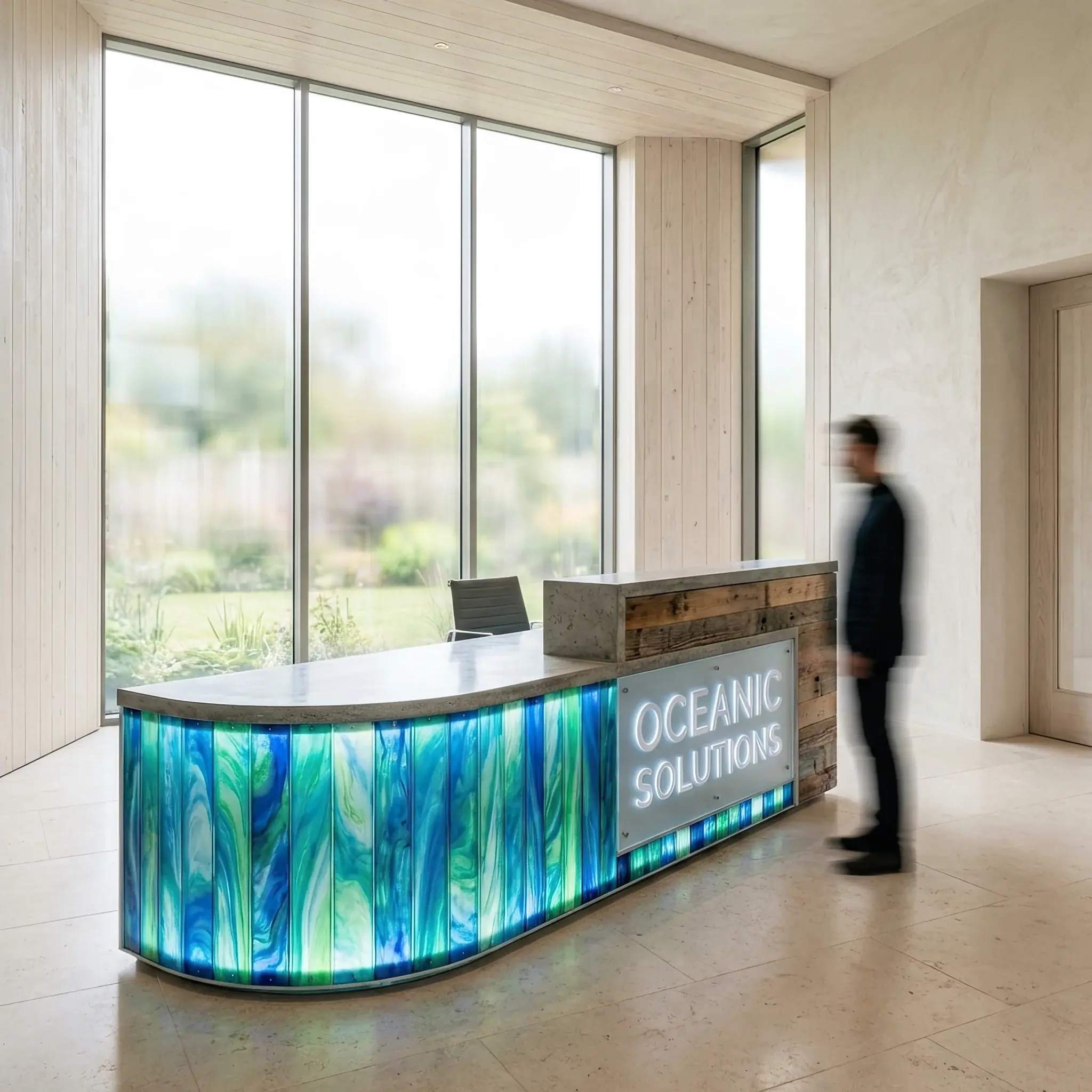
In 2026, sustainability has ceased to be a marketing slogan and has become a mandatory requirement for Class A+ real estate. Circular design is a philosophy where waste turns into a resource. We explore the 'Ocean Luxury' revolution: how abandoned fishing nets (Ghost Nets) and plastic waste from the ocean are transformed into high-tech composites for reception desks. Discover how large-format 3D printing allows for seamless, aesthetic, and fully recyclable products that tell a story of saving the planet right from your office doorstep.
Ghost Nets: From Waste to High Aesthetics
Every year, thousands of tons of nylon nets are abandoned in the oceans. In 2026, we use chemical recycling technology to turn this polymer into Econyl® granules, from which we create furniture facades. This material possesses unique color depth and strength. With correct lighting, an 'ocean nylon' reception surface resembles deep-sea water, bringing organic and ethical value to the lobby that regular plastic cannot provide.
3D Printing as a Zero-Waste Tool
Additive Luxury
The main challenge of working with secondary plastic is molding complexity. In 2026, we solve this with robotic 3D printing. The reception desk is printed entirely from recycled filament. This allows for complex biomorphic forms without creating molds (waste of which accounts for up to 40% in traditional production). Each such desk is a unique digital craft manifesto that can be returned to production and 'reprinted' into a new object in 10 years.